题目1:Global Dynamics of Reaction-Diffusion Systems with a Time-varying Domain
主讲人:赵晓强 教授(加拿大纽芬兰纪念大学)
时间:2025年12月9日(星期二)15:30-16:30
地点:理学院310会议室
主办单位:理学院
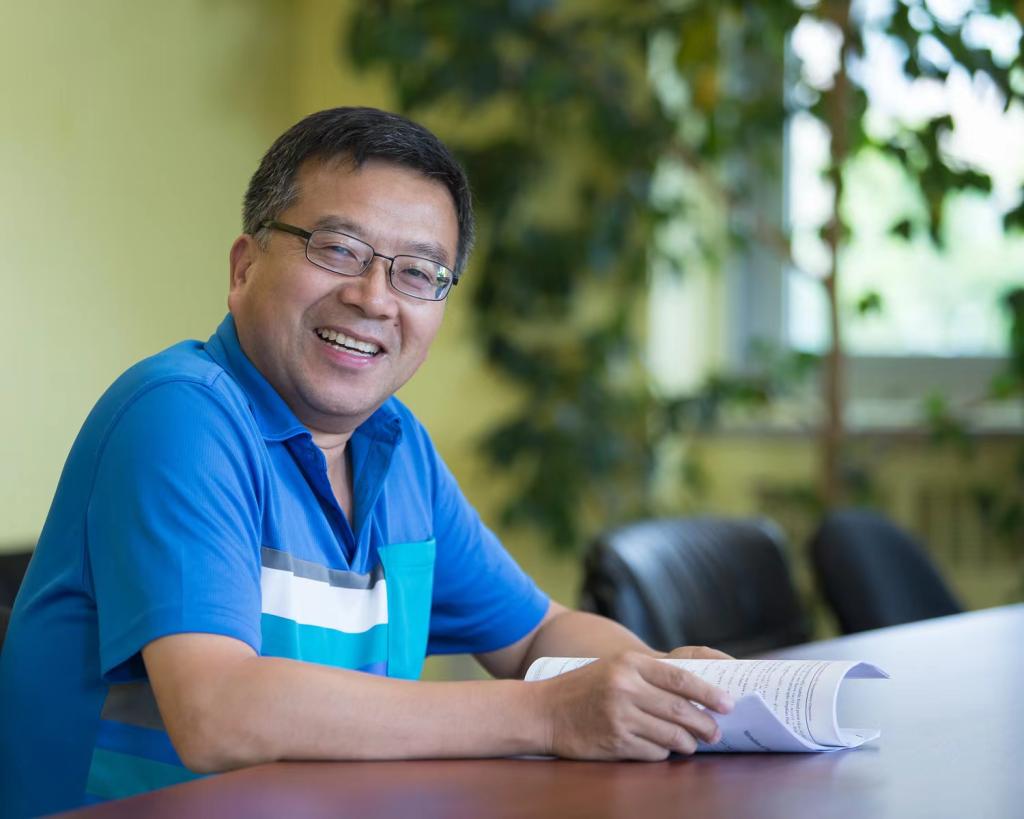
主讲人简介:
赵晓强,加拿大纽芬兰纪念大学数学与统计系教授,该校University Research Professorship荣誉获得者。赵教授先后于1983年和1986年在西北大学数学系获学士和硕士学位,1990年在中国科学院应用数学研究所获博士学位。赵教授长期从事动力系统、微分方程和生物数学相关领域的研究,在单调动力学、一致持久性、行波解和渐近传播速度、主特征值、基本再生数的理论及应用等方面的系列工作受到同行的广泛关注和引用。迄今为止,他已在“Comm. Pure Appl. Math.、 J. Eur. Math. Soc.、 J. reine angew. Math.、 J. Math. Pures Appl.、Trans. Amer. Math. Soc.、SIAM J. Math. Anal.” 等国际知名期刊上发表论文180余篇,并在Springer出版专著“Dynamical Systems in Population Biology”。赵教授个人主页:https://www.math.mun.ca/~zhao/
摘要:
In this talk, I will report our recent research on the global dynamics of a large class of reaction-diffusion systems with a time-varying domain. By appealing to the theories of asymptotically autononmous and periodic semiflows, we establish the threshold type results on the long-time behavior of solutions for such a system in the cases of asymptotically bounded and periodic domains, respectively. To investigate the model system in the case of asymptotically unbounded domain, we first prove the global attractivity for nonautonomous reaction-diffusion systems with asymptotically vanishing diffusion coefficients via the method of sub- and super-solutions, and then use the comparison arguments to obtain the threshold dynamics. We also apply these analytical results to a reaction-diffusion model of Dengue fever transmission to study the effect of time-varying domain on the basic reproduction number.
题目2:Modelling heterogeneities in disease transmission dynamics
主讲人:肖燕妮 教授(西安交通大学)
时间:2025年12月9日(星期二)16:30-17:30
地点:理学院310会议室
主办单位:理学院
主讲人简介:
肖燕妮,西安交通大学数学与统计学院副院长、数学与生命科学交叉研究中心主任、博士生导师,主要从事数据和问题驱动的传染病动力学的研究。 参与完成了国家“十一五”、“十二五”和“十三五”科技重大专项艾滋病领域的建模研究。 主持国家自然科学基金多项,包括重点项目1项、重点国际合作1项,主持科技部重点研发课题1项。2022年至今任中国生物数学专业委员会主任,2020年起任国务院第八届学科评议组成员(数学)。

摘要:
Accurate prediction of epidemics is pivotal for making well-informed decisions for the control of infectious diseases, but modelling heterogeneity in the system becomes a challenge. In this talk, we propose a novel modelling framework integrating the spatio-temporal heterogeneity of susceptible individuals into homogeneous models, by introducing a continuous recruitment process for the susceptibles. Then, a general human heterogeneous disease model with mutation is proposed to comprehensively study the effects of human heterogeneity on basic reproduction number, final epidemic size and herd immunity. We show that human heterogeneity may increase or decrease herd immunity level, strongly depending on some convexity of the heterogeneity function. Finally, we illustrate how to link the deep learning to dynamic model to examine time-dependent transmission rate or the intensity of interventions.


